D4 + D5 software workflow
D4 software scope closed. D5 demonstrated headlessly for single-bank P1, under SOFTWARE TEST ONLY conditions.
From a thermal requirement to an informed system choice.
Stable release · ready for validationHow can thermal loads, airflows and equipment performance be assessed together while keeping design assumptions and operating margins clear?
The process starts with operating conditions, then examines the required thermal loads and airflows. Equipment options are compared before the overall system balance and margins are reviewed.
The tool is designed to connect requirements, equipment selection and system-level checks in one traceable process. Software verification is reported with its limitations and does not replace qualification with suitable engineering data.
Software checks are kept separate from engineering validation. The results shown in demonstrations cannot be used as acceptance evidence for equipment, aircraft or complete systems.
I am developing this tool to connect the stages of an ECS sizing study within a traceable workflow. The project draws on my background in aircraft environmental control and thermal systems, with attention to the assumptions that link requirements, calculations and equipment choices.
The working approach is to define the operating case, examine the loads and available equipment, and review the resulting system balance and margins. Development and software verification are tracked separately from engineering validation on real data; the roadmap below makes that distinction explicit.
Status snapshot 1 November 2026 · V0.9.21
The development plan separates completed software checks from current work and the next steps. Software testing does not replace engineering validation of the system.
Release stable-8919ef46-r1.1 is available as the basis for engineering validation. Completed checks cover software behaviour only in the single-bank configuration — SOFTWARE TEST ONLY.
D4 software scope closed. D5 demonstrated headlessly for single-bank P1, under SOFTWARE TEST ONLY conditions.
Component selection, results review, applying changes and saving and reopening the project have been verified.
The next phase starts with synthetic-data checks, followed by validation using suitable real-world data. Engineering validation remains open.
Requirements, architecture and component libraries.
Established software foundations; equipment data quality and engineering validation remain separate.
Calculation workflow and candidate assessment.
Completion refers to the agreed software scope, not continuous-domain or hardware validation.
Headless workflow: single-bank P1.
SOFTWARE TEST ONLY. Completion does not establish a fully integrated desktop workflow or equipment acceptance.
The complete interface workflow has been verified for the single-bank test case.
PDF reporting checked within the software scope. Alternative ranking is not yet demonstrated.
One validation stage: synthetic data first, then real-world data.
Synthetic-data checks will assess model consistency, assumptions and behaviour, including guided use of the tool. Validation with real-world data will require reliable sources and defined acceptance criteria. Neither activity is reported as complete.
Chart display and messages for unavailable data or resources have been checked.
The configuration and source associations are preserved. A new evaluation is required after reopening to obtain current results.
PDF reporting has been checked within the software scope. The graphical aircraft catalog remains planned, not yet implemented and unscheduled.
Original planning windows and newly scheduled activities. The dashed line shows the current date and updates automatically; bars do not show completion percentages.
Stable release · ready for validation.
Component selection, results review, applying changes and saving and reopening the project have been verified.
single-bank — SOFTWARE TEST ONLY. Software verification does not establish engineering validation.
← Scroll the chart to view the original dates →
D4/D5 software checks completed for the P1 test case.
D5 was verified for one equipment bank. These checks establish software behaviour within the declared test scope, not aircraft-system validation.
Calculation, candidate selection and review verified.
The accepted software workflow includes candidate selection and review. Current session results remain distinct from imported project inputs.
Software acceptance recorded; engineering validation remains open.
The Rev07 update records scoped software completion. Historical forecast dates are retained. The aircraft-family catalog is planned, not implemented, with no dates or estimates.
Stable Windows release checked and available for the next phase.
The release summary records Windows interface checks, targeted regressions, backup and restore checks. These results apply to stable-8919ef46-r1.1 within the declared software scope.
Native Apply and save/reopen verified within the test scope.
The accepted case covers a confirmed Apply, saving to a new file and reopening through the production loader. Source associations persist; current source payloads and review authority are not restored by reopening.
Original planning-review window.
The original 3 November review window is retained for reference. The new validation activities are shown below.
Further development and model checks using synthetic cases.
A planned period of 56 consecutive days, including weekends and holidays. Previously completed software checks remain separate from this new activity.
Comparison with real-world data against acceptance criteria.
A planned period of 42 consecutive days after the synthetic-data phase. Suitable real-world data and defined acceptance criteria are required.
Plan updated on 1 November 2026: 8 calendar weeks for software validation with synthetic data, followed by 6 weeks for engineering validation with real-world data. These are planned dates, not evidence of completed work.
single-bank — SOFTWARE TEST ONLY. Software checks do not establish engineering validation or certification.
Actual R1.1 software screens with synthetic inputs after reopening the project. No new calculation: dashes indicate unavailable results, not zero. single-bank — SOFTWARE TEST ONLY.
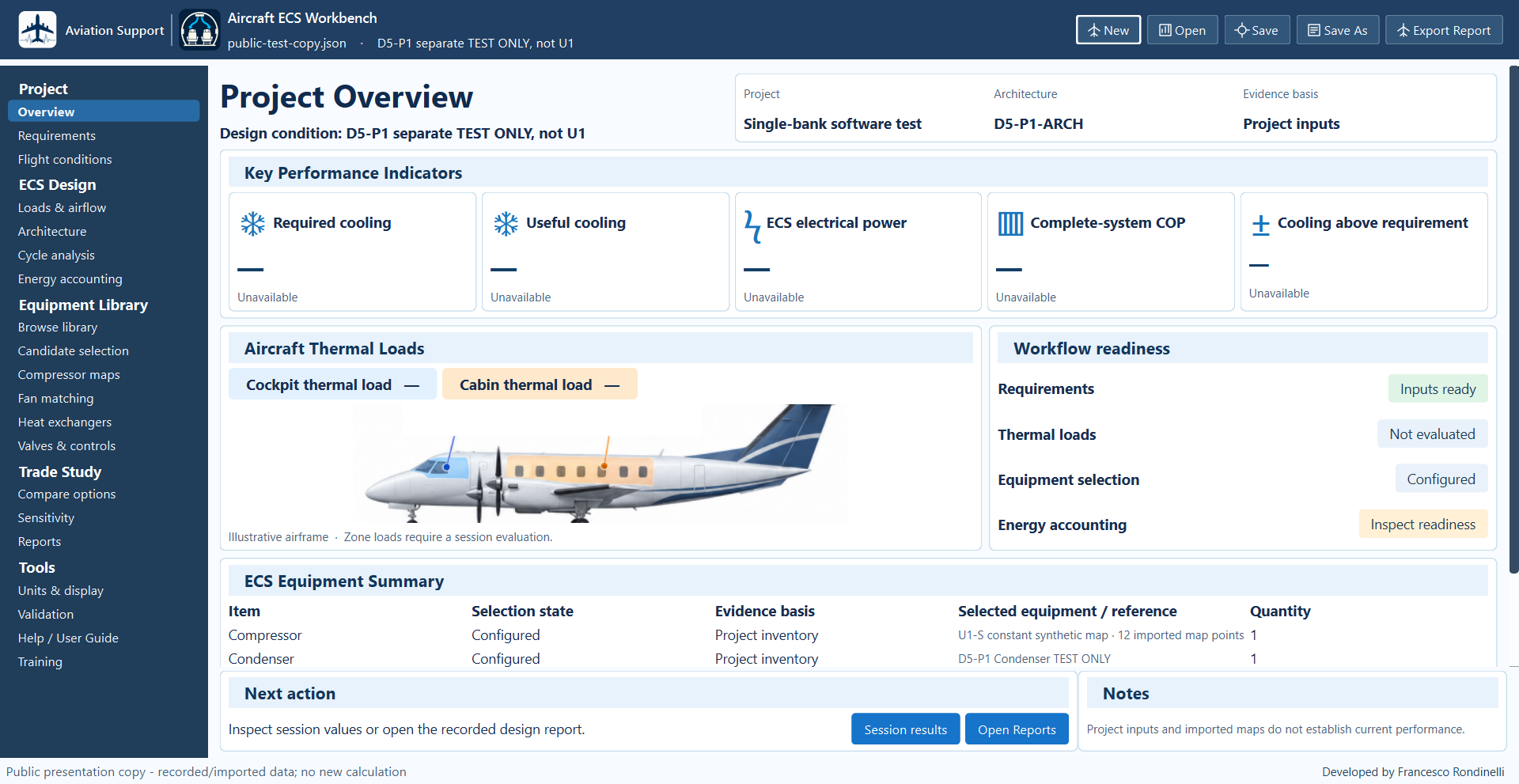
Project inputs and available indicators after reopening.
A structured environment for exploring environmental control system sizing, equipment candidates and design trade-offs.
Organise aircraft conditions and cabin and cockpit thermal loads into a consistent sizing workflow.
Work with compressor, fan and heat exchanger information. Compare eligible candidates and record selection rationale.
Review architecture, cooling capacity, electrical demand and available margins together.
Connect equipment selection and system accounting to their engineering context as the design evolves.
Illustrative presentation with synthetic values. Not a software screenshot or validated sizing result.
Contact Francesco to discuss the workflow, its scope or a potential technical collaboration.
Get in touch →