My approach to project management is built on more than twenty years of aerospace work with manufacturers, suppliers and airlines. PMP® certification and an Executive MBA have helped me add formal planning and management methods to this hands-on experience.
I start with the project goals, the work to be done and the people involved. I then define responsibilities, dependencies, milestones and reviews. A good project plan should help the team make day-to-day decisions, not simply describe a list of activities.
Technical projects change as requirements become clearer. My priority is to make open questions visible, understand how changes affect the plan, and keep engineering activities connected with operational needs and business priorities.
01
Connect people and priorities
Working with engineering teams, customers and suppliers has shown me why clear communication matters. Shared priorities, defined responsibilities and an open list of questions help people understand what needs to be decided and who should act.
02
Bring structure to uncertainty
I review scope, schedule and risk together. When an assumption changes, the team needs to understand which activities depend on it, what evidence is still missing and whether the plan should be updated. This keeps engineering knowledge at the centre of project decisions.
03
Choose methods that fit the work
I use a practical approach to project delivery. Formal reviews are important when requirements and acceptance criteria are fixed, while short development cycles help when designs or software requirements are still evolving. The aim is to choose the method that fits the work and keeps people responsible for the final decisions.
From the project charter to day-to-day decisions, Project Cockpit brings essential information together in one local desktop application.
Define a charter, maintain stakeholder records, structure the work and review a manually managed schedule. Track logged time and remaining cost estimates against a selected baseline, with explicit records for deliverables, milestones, risks and decisions.
The project manager owns the assumptions, reviews and decisions.
01 / Define
A shared starting point.
Project Charter, stakeholder register and work breakdown structure.
02 / Control
Progress in context.
Manual scheduling, selected baselines, logged time and remaining estimates.
03 / Decide
Explicit delivery records.
Acceptance criteria, milestone decisions and qualitative risk assessments.
Inside the application
R01 in practice.
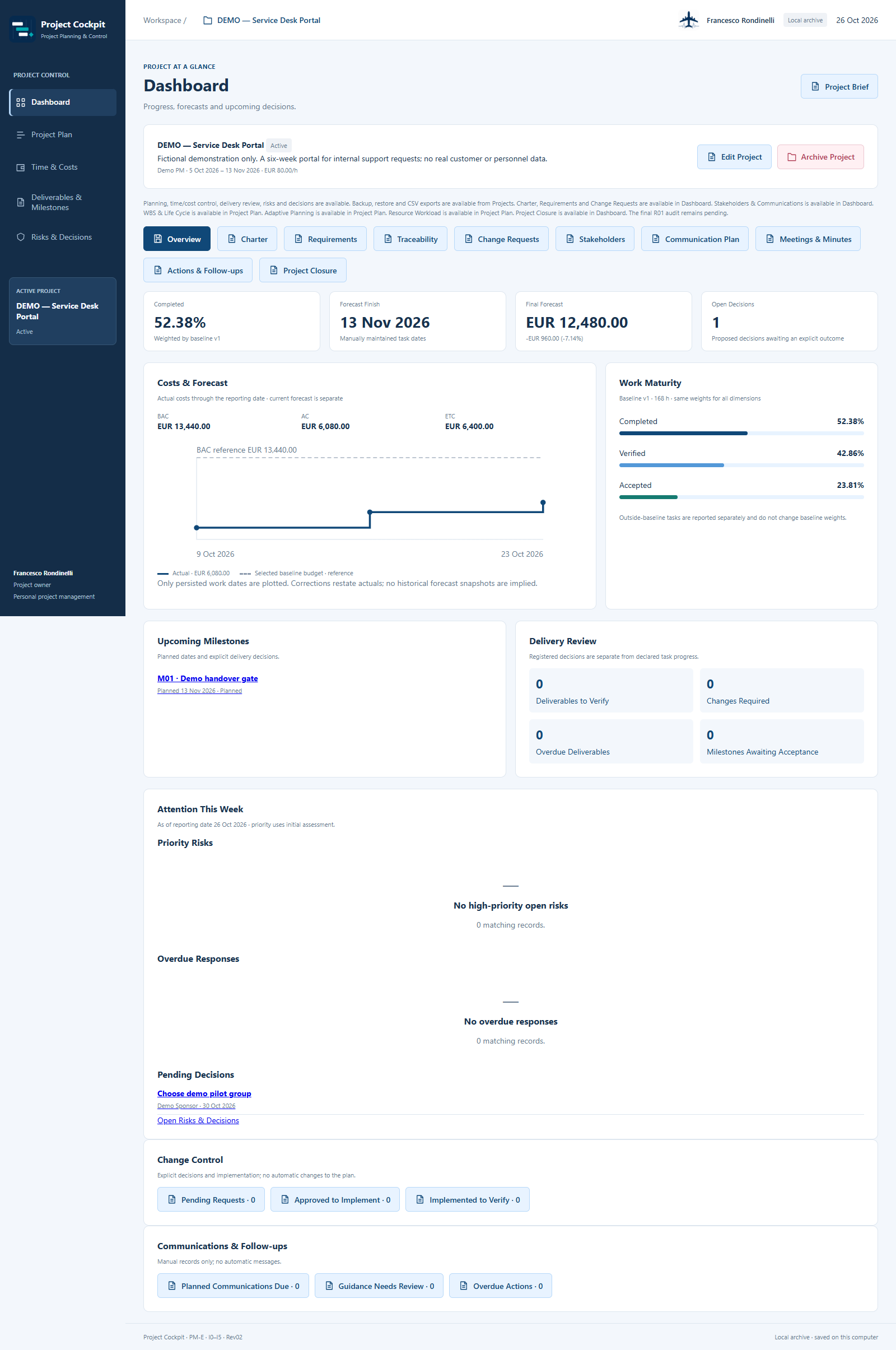
Demonstration captured 26 October 2026
R01 / Dashboard
Review project status, cost forecasts and upcoming decisions in one workspace.
Actual application views · fictional demo data · select a view, scroll inside tall screenshots or enlarge.
Scheduling is manually managed. These views do not demonstrate automatic critical-path calculation or resource levelling.
Development preview
What’s taking shape in Next.
Next · Development candidate
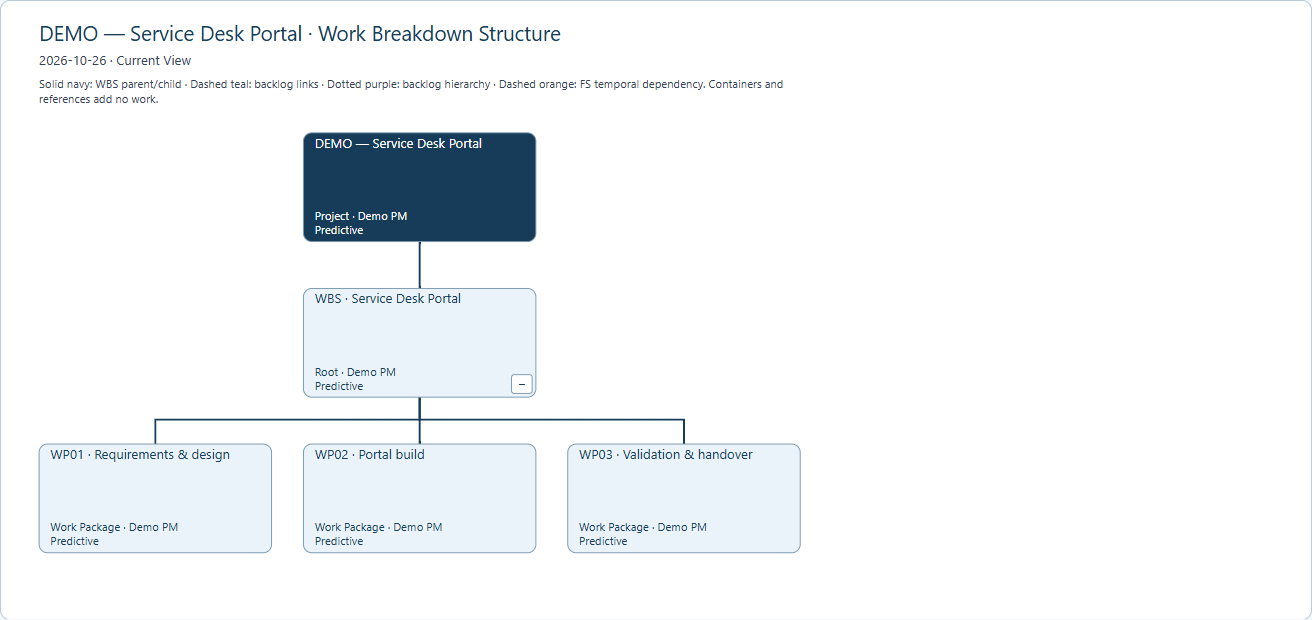
Next is separate from the preserved R01 release. The demonstrated additions include a graphical WBS and an AI Assisted preparation workflow, with saved Charter content selected and previewed before transmission.
AI verification stops at the preview. No AI generation was performed. Live generation, proposal quality and end-to-end application still require controlled testing.
Next / WBS diagram
Two WBS levels: one root and three work packages, plus the automatic project heading.
Actual application views · fictional demo data · select a view, scroll inside tall screenshots or enlarge.
Proposed development plan
Build on what is demonstrated.
Development priorities from the October review. Scope and acceptance remain subject to project-manager review.
01 / Consolidate
A repeatable Next candidate.
Consolidate the release, improve readability and verify a controlled live AI workflow with explicit review and selective application.
02 / Refine
Clearer planning and review.
Introduce a compact WBS view, develop stakeholder engagement and communications review, and verify a declared set of import/export formats.
03 / Explore
Scheduling automation.
Assess calendars, constraints and resource rules before deciding whether to implement automatic scheduling. This remains an optional discovery topic.
Proposed work, not released functionality or committed delivery dates. R01 remains the preserved reference while Next develops.
Interested in the project?
Discuss project planning, practical workflows and development priorities.
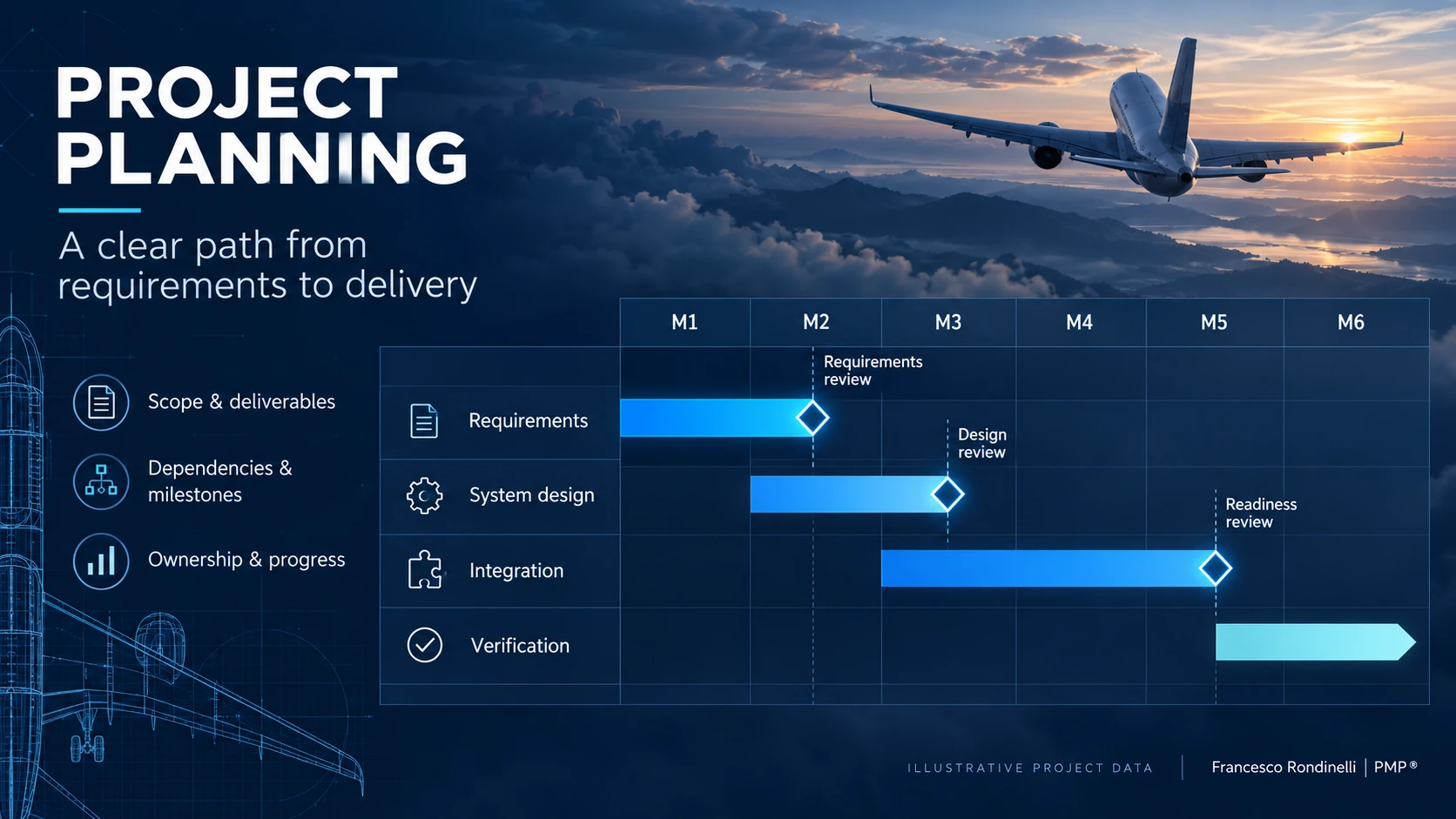
Define scope and deliverables, map dependencies and milestones, and make ownership clear.
The following illustrations explore planning, risk and delivery methods. Schedules and status examples are demonstration content, not results from a named customer programme.
A clear programme direction. Short learning cycles. A delivery approach tailored to the uncertainty, interfaces and assurance needs of the work.
01 / Establish the framework
Plan the commitments.
Define requirements, programme milestones, budgets and responsibilities. Make supplier interfaces, acceptance criteria and decision authority explicit.
02 / Learn through delivery
Iterate where it helps.
Use a prioritised backlog, prototypes and short reviews for software and uncertain design work. Incorporate feedback without losing sight of the agreed requirements.
03 / Connect the evidence
Review before release.
Link incremental results to programme milestones. Maintain configuration control, requirements traceability and verification evidence as the solution evolves.
An aerospace application
For an ECS analysis tool, an overall delivery plan can define interfaces and validation milestones while short development cycles refine equipment selection, calculations and reporting. Each increment is reviewed against explicit acceptance criteria before it supports the next programme decision.
Illustrative application of the approach; not a claim of certification or a customer programme result. Iteration does not replace required qualification or approval activities.